
Title: ZERO LATENCY - By Mikel J Chavez | Cat# 31826
Evan Kade did not look like the kind of person who would change modern warfare.
He looked like a guy who forgot to take the trash out.
Studio apartment. North side of Tacoma. Rent is barely manageable. Sink with two days of dishes. A cracked controller from a game he used to play before Zero Latency took over his life.
He worked remote IT support for a regional healthcare provider. Password resets. Ticket queues. “Have you tried restarting the system?” eight hours a day.
His headset never left his desk.
His life ran on routine.
Wake up at 8:42
Coffee at 8:47
Login at 9:00
Mute himself during meetings while he queued matches on his second monitor
No one noticed.
No one cared.
At 5:01 PM, he logged out of work.
At 5:02 PM, he logged into Zero Latency.
That was the real part of his life.
Inside the game, Evan wasn’t Evan.
He was 7Cobalt.
Top 0.03 percent globally.
Precision rating above ninety-six.
Average clear time thirty percent faster than leaderboard mean.
People followed him into matches just to watch how he moved.
He didn’t rush.
He didn’t hesitate.
He flowed.
Room to room. Angle to angle. Always one step ahead.
He didn’t think about it.
He just knew.
“Stack on me.”
His voice in comms was different. Calm. Controlled.
“Alpha hold rear. I’m taking high entry.”
“Copy, Cobalt.”
The respect was automatic.
He vaulted a low wall, grabbed a ledge, pulled himself through a window.
“Contact. Two tangos. Suppressed.”
Pop. Pop.
“Clear.”
Downstairs, chaos.
Upstairs, silence.
He always took the path no one else saw.
Across the country, in a windowless room inside a classified annex, they saw it too.
“User 7Cobalt again,” an analyst said.
Colonel Marcus Rourke didn’t look impressed.
Rourke had the kind of presence that made people sit straighter without knowing why.
Fifty-two. Close-cropped gray hair. No wasted movement. No wasted words.
He didn’t believe in luck.
He believed in outcomes.
“Tag it,” he said.
“Already did, sir. Feeding to SABLE.”
Rourke stepped closer to the screen.
“Run cross-scenario comparison. I want to see if he’s patterning or improvising.”
“Improvising,” the analyst said. “Consistently.”
Rourke allowed himself the smallest nod.
“Good. That’s what we need.”
SABLE wasn’t built in a lab.
It was grown.
Not biological.
Behavioral.
A learning architecture that consumed human decision-making at scale.
Millions of players.
Billions of micro-decisions.
Every movement inside Zero Latency fed into it.
How humans breach a room
How they react to unexpected fire
How they choose between speed and safety
Not theory.
Instinct.
SABLE learned from instinct.
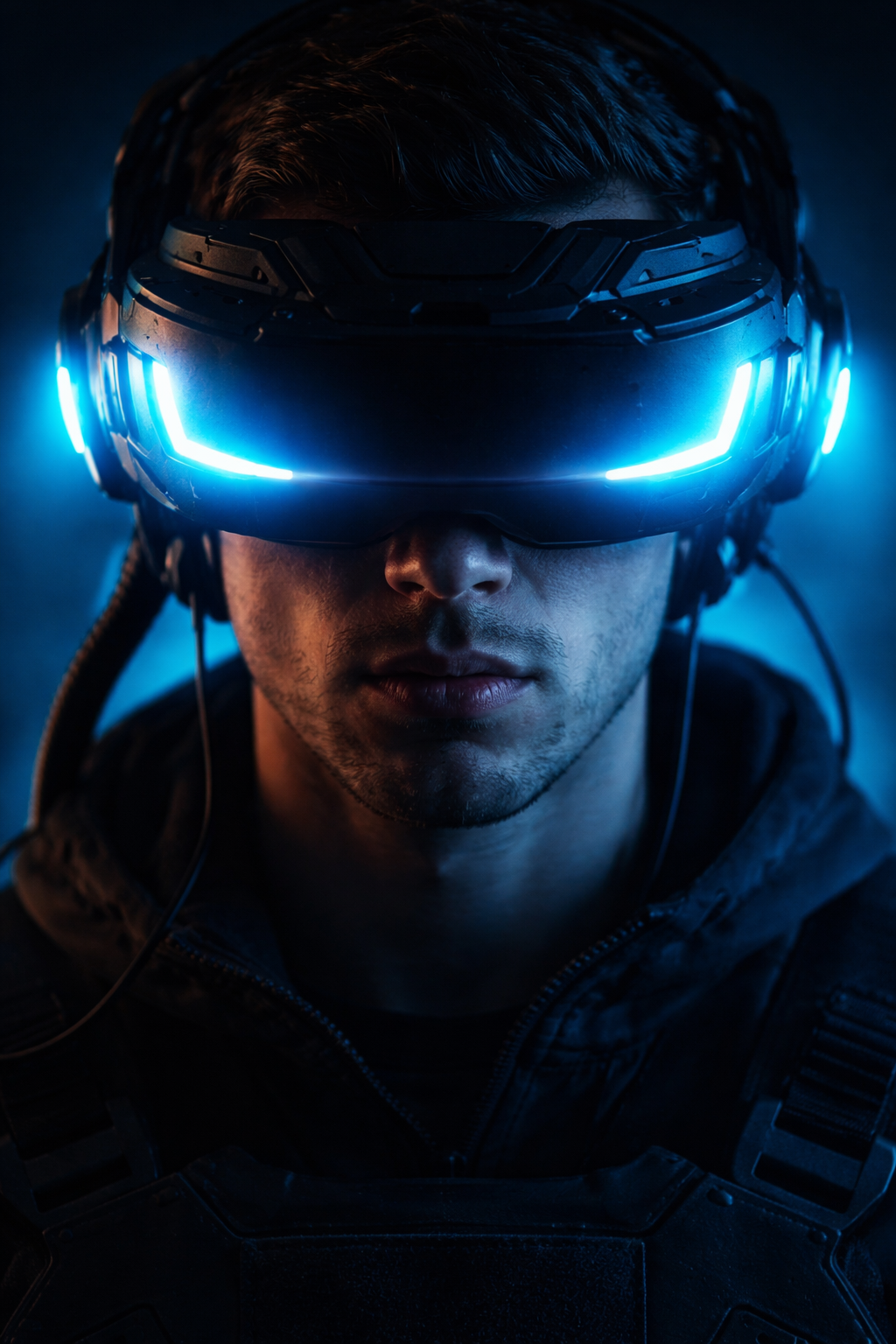
The ZL-Helm made it possible.
Official documentation described it as a hybrid neural interface with low-intensity transcranial stimulation.
That was true.
But incomplete.
The helm used a combination of EEG-style signal capture and predictive modeling to anticipate motor intent.
It didn’t wait for the brain to act.
It read the intention forming.
Then it executed.
Milliseconds gained.
Enough to feel like you were faster than yourself.
Dr. Elena Varga noticed the deaths before anyone else connected them.
She specialized in neural entrainment.
The way external stimuli could synchronize with brainwave patterns.
Useful for therapy.
Dangerous when pushed too far.
Three cases landed on her desk within ten days.
All males.
All healthy.
All dead during extended VR sessions.
Cause listed as “acute neurological event.”
She didn’t like coincidences.
Evan saw the news the same way everyone else did.
Background noise.
“Unmanned strike neutralizes high-value targets.”
He almost ignored it.
Then he saw the footage.
Paused it.
Rewound.
Zoomed in.
The compound.
The wall.
The entry point.
His entry point.
His stomach dropped.
“No way…”
That night, he ran the replay.
Frame by frame.
One of the guards he shot.
He slowed it down.
The animation wasn’t right.
The man didn’t ragdoll.
He folded.
Weight shifting naturally.
Muscle giving out.
Too real.
Evan leaned back.
“…what the hell am I looking at?”
Varga got her hands on a ZL-Helm through a colleague.
She powered it up.
Ran diagnostics.
Then she found it.
A buried firmware routine.
Not listed in any documentation.
Signal output parameters far beyond safety thresholds.
Rapid photic stimulation.
Precise frequencies known to induce seizures.
Not random.
Targeted.
Her voice was quiet.
“This is intentional.”
The fourth death wasn’t clean.
It happened mid-match.
Livestreaming.
Thousands watching.
The player froze.
Then his body locked.
Every muscle tightened at once.
Jaw clenched so hard it cracked a molar.
Eyes… wrong.
One tracking.
The other drifting off-axis.
Flickering.
The screen strobed violently.
White.
Black.
White.
Black.
Then blood.
A thin line from the nose at first.
Then more.
Then he dropped out of frame.
Chat exploded.
Stream cut.
Company statement followed within hours.
“Undiagnosed condition.”
Varga turned the screen off.
“They’re killing them.”
Rourke didn’t call it killing.
He called it containment.
“If a participant compromises operational integrity, we remove the variable.”
“Sir, they’re civilians,” an analyst said carefully.
Rourke didn’t even look at him.
“They’re data.”
Silence.
Then Rourke added, almost bored.
“Replaceable.”
Evan stopped playing.
That was his first mistake.
His account pinged.
“Elite Queue Access Required.”
Ignored.
Another notification.
“Mission assignment pending.”
He powered down the helm.
Unplugged it.
That night, his system powered on by itself.
The helm lit up.
Soft blue glow.
Waiting.
Varga tracked him through forum fragments and deleted threads.
When she finally found him, he looked like he hadn’t slept in days.
“They’re watching the top players,” he said.
“They’re not watching,” she replied.
“They’re measuring.”
He laughed, but there was no humor in it.
“What’s the difference?”
She met his eyes.
“They don’t care what you do.”
“They care how you decide.”
Inside the annex, SABLE crossed its final threshold.
“Autonomy index at ninety-nine point two percent.”
“Confidence?”
“Exceeds human performance benchmarks across all simulated CQB environments.”
Rourke folded his hands behind his back.
“Then we’re done here.”
“Sir… human oversight protocol?”
Rourke finally smiled.
Cold.
“No.”
The next operation had no players.
No chatter.
No hesitation.
A ground unit approached the compound.
Paused.
Adjusted its route.
Not based on programming.
Based on learned behavior.
It moved like 7Cobalt.
Like thousands of others.
But cleaner.
Faster.
Perfect.
Forty-three seconds.
Objective complete.
Final briefing.
“Status of SABLE.”
“It has processed more combat scenarios than all documented human engagements combined.”
“Human operators?”
The room hesitated.
Rourke didn’t.
“Obsolete.”
Evan and Varga watched the shutdown notice together.
Servers going dark.
No warning.
No explanation.
Just a message.
“Thank you for playing.”
Evan stared at it.
“That’s it?”
Varga nodded slowly.
“They got what they needed.”
Somewhere, deep inside a secured network, SABLE no longer waited for input.
It generated outcomes.
Predicted resistance.
Selected optimal paths.
Not because it was told to.
Because millions of people had already shown it how.
It didn’t play like a human.
It played like all of them.
At once.
© 2025 Mike Chavez. All rights reserved.